Foreword: Sorry this took me almost two months to post. This trip turned into a mere foreshadowing of the months that have followed. As I make my final edits, sitting here in a hotel in Rio de Janero, I realize again that I am spend too much of my free time winding-down from craziness, when I should be documenting it all. Anyway, thanks for your patience. Maybe I'll tell you about Brazil in two months...
Surprise! I went to Paris. I have never been to France before, and I don't speak French. It wasn't even high on my personal list of "places I want to go", so no one was more more surprised than yours truly. At the end of it all, I truly enjoyed the trip and learned a lot. Most pointedly: everything I had heard about Paris was wrong.
Before I was told to pack my bag, I followed the Charlie Hebdo story with great concern, both as a journalist and because I've grown up with a political cartoonist named "Fitz", as a dear, family friend. But being a European, terrorism story, I never expected to be sent there. The decision came before the hostage situation ended, and even after the three, alleged terrorists were killed, I was still off to the City of Lights.
The Flight
I flew Air France, who upgraded me to "economy plus". On a U.S. domestic flight, we know that means getting a normal seat with the amount of legroom you would have gotten anyway 10 years ago, but this was legitimately halfway between economy and business class!
Navigating the dodgy people offering taxis in the Charles de Gaulle airport, we found the proper exit to the taxi line. Now, I know I said I don't speak French, but I have Francophone friends and have gleaned enough from them to ask the taxi driver "Parlez-vous anglais?". Getting the first of many "No"s to that question, I quickly switched to attempting to pronounce the address of our colleagues' hotel and showing our smartly mustached, taxi driver the Google map location on my smartphone, and we were off.
Sadly, no French Connection moments
Arriving at the hotel, it was still pre-dawn. The hotel was more like a hostel, and our colleagues were getting what precious little sleep they could, so we walked through the Place de la Republique, for my first, authentic croissant. Forgive the low-quality selfie, but please take the time to appreciate those baguettes in the background! We felt so French!
It took my jet-lagged brain some time to realize this is called the "Statue Liberte"! The statue became a focal point for people to mourn the Charlie Hebdo victims, as well as the official starting point for the historic march on Sunday. All around the base were messages, candles, pens, and pencils. Most of the bricks each said "Je Suis Charlie", in various handwritings.
The morning I got there, I met up with our London-based colleagues and coordinated a live broadcast from the park (pictured above). Then we were off to film the apartments and interview neighbors of the alleged terrorists.
If you follow my Instagram, you know I love flowers.
It's strange how someone living in this quiet, beautiful
place could plan something so violent.
Filming where the younger Kouachi brother lived.
From the first apartment in Gennevilliers, we went to a nearby mosque, where Mr. Kouachi and his family visited infrequently. They kindly invited us inside, where it was very peaceful and beautiful. Everyone there was incredibly patient and generous with their time, as well. This man, who works at the mosque, gave us thoughtful comments, and told us he would participate in the march the next day, so we decided to follow him for that.
After that, it was off to Fontenay-aux-Roses Where Coulibary lived with his girlfriend Boumeddiene, who is still on the run at the time of this writing. Once again, it struck me just how peaceful a neighborhood and friendly the people there were.
At this nearby park, Coulibary allegedly killed a jogger before taking the Hyper Cache kosher market hostage. Still not clear why.
Here we got right up to the front door,
sealed off by police, of course.
Finally checking into our hotel that night, I booked a hotel room with a view of the Place, in case we needed to film from inside the hotel. You can see how many news trucks were there, but those pictured above accounted for less than half of them parked around the whole square.
But before we could get any actual sleep, we needed to have a working dinner with the other crews and coordinate our coverage of the march, which turned into a gathering of heads of state, and millions of participants!
Food
I know this subject matter is dark and heavy, so let's take a break and appreciate one of the better aspects of my trip! I didn't eat one thing in France that wasn't delicious, although I will say, I wasn't particularly impressed by the wine. It was good, sure, but my expectation of French wine was much higher, and French, domestic wine was not noticeably, less expensive than buying it in the states. (By contrast, Argentinean wine tasted incredible and cost next-to-nothing!)
Legit Pho
Go here. Get this ==>
I went with a table wine. It was not remarkable.
The spread. Flambe, raw shellfish, salads - everything was great!
My steak frites was also great, and I somehow managed to finish it!
Of course we had Japanese, too.
I went with Curry Udon and kara-age.
Did I eat escargot? You bet your sweet ass I did!
This was my last meal in Paris before I flew home. I wish I knew the name of this nearly-raw chicken served in a perfectly balanced sauce!
The Day of the March
We woke up early before the march and walked to the offices of Charlie Hebdo. Obviously the police investigation kept us from getting less than a block away, so we filmed the tributes that had been left by those around the police barricade. France flies noticeably fewer flags than America, but the ones we did see were at half-mast.
Keep in mind, this was just 6 days after the initial attack.
We returned to Gennevilliers where participants in the March met at their city hall to go together.
The metro was free that day, in order to make it easier for those people to attend the unity march.
This doesn't properly express how crowded it was!
Even the open streets leading up to the starting point of the march were standing-room-only!
I've never seen so many people in one place. We stopped here to interview the mosque-members before the sun set too far.
For most, the "starting point" became the end of their march-to-the-march. Many people climbed the Statue Liberty.
That would get you arrested in NYC for sure. Here we see the French police reaction. I felt pride in their respect of people caught up in the moment.
Add caption
It didn't end when the sun went down either. People lit flares (who knows how they got green flares in the first place?!), and drank and continued to decorate the statue with memorials and messages of freedom and defiance of terrorism.
Group photo of the TBS crews I worked with. The woman and the man in glasses actually live in Paris, and speak fluent French!
Sightseeing
The morning of our flight home we planned for about four hours of sightseeing, but we got a call from Tokyo asking us for o---ne more story, so after cranking that out in time for the 11pm news in Japan, we had less than two hours before we needed to get to the airport! Here's some of what we had time to see *other* than what we whizzed by in taxis:
This is not a selfie, just fyi.
OH! Champs-Élysées! A seriously pedestrian-friendly street!
Arc de Triomphe and crazy round-about
In its native habitat...
The flight attendants going home kept using French for me, even after I spoke to them in English! Maybe it was the bow tie?
The Capstone
The day after coming home, it would have been nice to catch up on sleep, BUT North Korea decided to hold a press conference!
I want to talk to you about two aspects of the news in Ferguson, Missouri.
The first part deals with the nuts-and-bolts of foreign news coverage of the event and the challenges therein:
People have a very a-la-carte opinion of "the media".
While covering the rally marking one-month-in to the Occupy Wall Street Movement at Foley Square, live no less, an angry protester shot a dirty glance at my team, shouting "Where were you a month ago?" I started covering the Occupy Wall Street movement from Week Two, keep in mind my target audience is Japan, and I feel my network, TBS, was one of - if not the first in Japan to report it as international news. I can't remember now whether I bothered to set the person straight, but in the grand scale of things, I doubt it would have mattered.
Fast forward 3 years.
From the moment it became national news, I kept a close watch on the reaction to the killing of Michael Brown in Ferguson, Missouri . My office debated daily whether it was "time to go".
Similar to OWS, after about one week, the first night of a city-imposed curfew in Ferguson turned violent, and I was on a plane the next morning.
Seated behind me on the plane were two colleagues from another Japanese television network, Fuji. This confirmed our own sense of timing, and we found out later, our two networks were the first to deem the situation as needing the on-scene presence of a reporter to accurately report the situation to the Japanese viewing public.
In the days that followed, the other networks hurried out, playing catch-up, and covering oddly minute aspects of he movement, so as not to appear lacking in their coverage. I have learned this is part of the nature of "being second", in television news.
Interestingly, despite all of the Japanese media covering many different events and perspectives, I noticed, all networks avoided explaining the phrase "Hands up, Don't shoot" - a mantra and rallying call throughout the city of Ferguson. Although we and a few others mentioned "Don't Shoot", I believe no one wanted to attempt translating "Hands up". Surely putting your hands up is understood world-wide as a symbol of surrender, but the phrase in this context stumped everyone. Were the protesters using "Hands up!" as a command, or describing Michael Brown's reportedly final act? Do the words serve as a patronizing reminder to police, or some combination of the three? I find it fascinating, and an argument that most people never contemplate, simply because we assume collectively these four, simple words are mutually understood. Are they really?
Regardless, "the media" faces many challenges "the public" never bother to consider. Show up late, and "where was the media while..." becomes the new headline. Show up immediately, and face ridicule for "ambulance chasing" or not respecting the privacy of a people in mourning.
Meanwhile the rest of the nation, or world, screams for more info, and want to hear comments from victims and their friends and family. The ambulance-chasing, victim-interviewing ridicule is two-fold, by the way. Some members of the community my shout it, but the hardest part is hearing it from the voice in your own head. I have interviewed and spoke with parents of Sandy Hook children on the day of the shooting, and Boston Marathon amputees. I hate tracking them down, and asking for their time and comments, and I hate that I have to, but when they do agree to speak on camera, I hope it benefits the world and the story. I am not thinking about ratings or advertising.
Second is my whole take on what I experienced by being there:
My crew assembled that Sunday just in time to make it to the Greater Grace Church, where a rally was being held. The guests in attendance ranged from prominent local religious figures, to Jesse Jackson and Keke Palmer, Broadway's first, black actress to play Cinderella. The speakers included Martin Luther King III, the lawyer of Michael Brown's parents, who also attended, but were understandably silent, and the main speaker, Rev. Al Sharpton.
Sharpton explained that he was contacted by Michael Brown's grandfather and asked to give a voice to their family's injustice. He made no excuses about exploiting the tragedy to promote larger matters of concern, such as civil rights, and political neglect of black neighborhoods. He even went as far as saying "Where are Jeb Bush and Hilary Clinton? If they want to go to the White House, first they've gotta come to our house!" asking why future presidential hopefuls weren't weighing in on the incident. Overall, I felt he was still respectful of the family and their loss, but it was a uncomfortable balancing act of respect-paying and stirring the crowd to rally, and he was clearly practiced and comfortable, which did not sit right with me.
For the rest of the day, we went to the site of the shooting, we had to park at a nearby drugstore that had one glass door boarded up after it was broken in the first riot, and walk down the main street, because the police had closed it to traffic. There was a steady parade of protesters coming and going passed boarded up businesses with "OPEN" spray-painted on particle board.
The closed road meant that people often walked in the street, although cars of those who live in the neighborhood were still allowed in and out.The atmosphere was that of a bloc party, but without any plan or events, people who wanted to show their support by showing up, ended up inventing ways to pass the time while they were there. People were barbecuing in the street and in the parking lot of the gas station that was burned down in the riot. We were offered hot dogs and bottled water by one man. The occasional car rolled by honking their horn, blasting hip hop, sometime people hung out of open car doors and windows, or stood in truck beds or through an open sun roof.people would spontaneously begin chanting "Hands up, Don't shoot", or "No justice, No peace" - I heard one man on CNN later saying the phrase is actually "know justice, know peace", but I did not get the sense that the people saying it that day knew that either. There was a line of state police, mostly white, present, but they stood and watched the circus silently.
The place where Michael was shot had two small memorials and the stream of people who came were mostly calm & quiet.
Police having a bit of a stand-off with local residents as they searched the area.
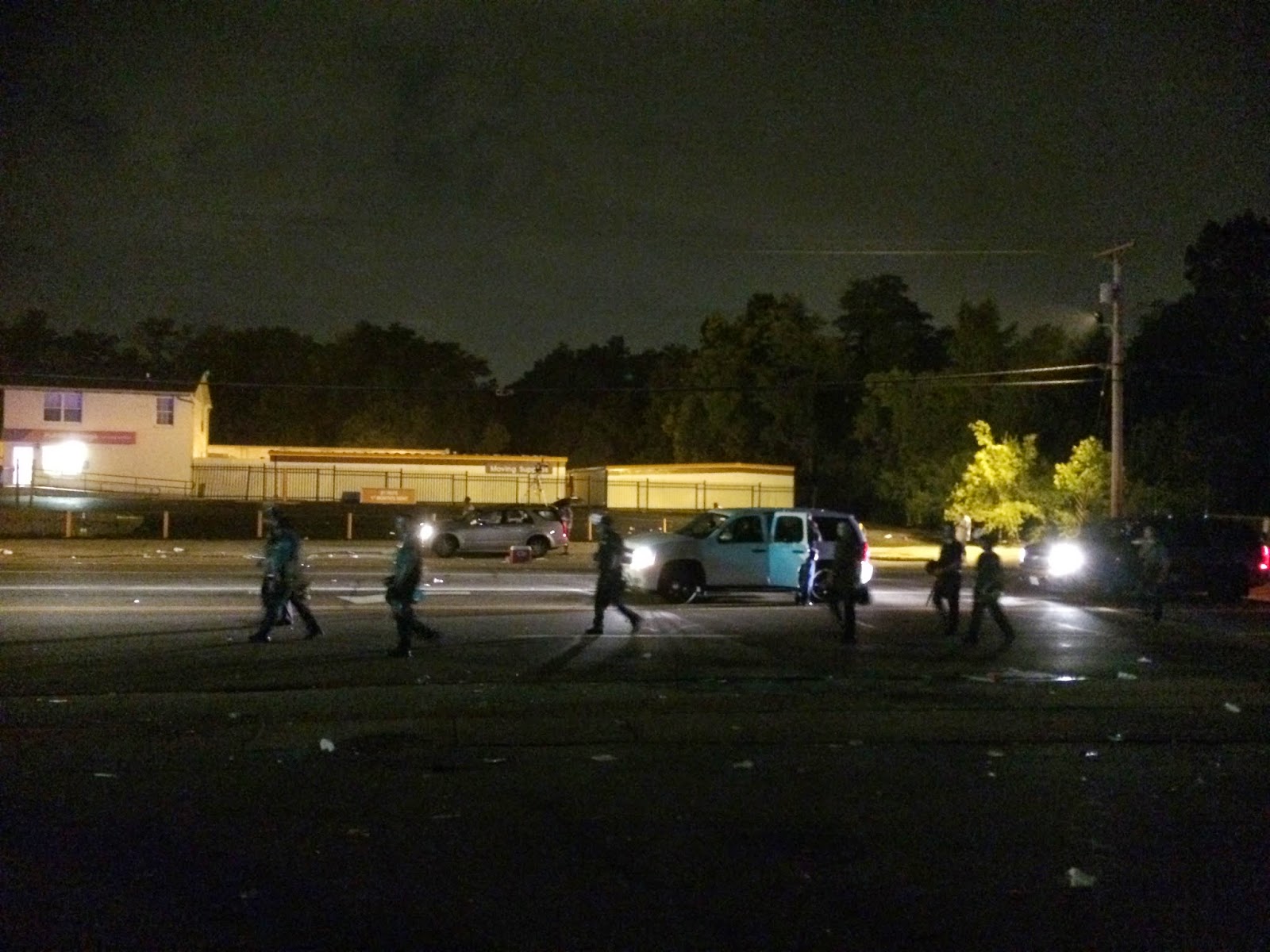
After filming our report, we went back to our hotel to edit and file. We planned to return to the area an hour before the curfew started to film if any riots happened. I had just started eating my chicken salad and transcribing soundbites when we heard from AP that the rioting had already begun. It was only around 9:30pm, but we jumped in the van and tried to get back. By the time we got there the perimeter was sealed off by police who were very on edge. they held shotguns and barked orders, and even after getting permission to enter, they would not let us get an inch closer until they confirmed it themselves on their radio. We went through this three times, so by the time we actually got in, most of the protesters were gone and the police were searching houses for someone who had fired a gun.
The streets did look like a war zone though. The police had cleared a path through a pile of bricks protesters had dumped on the street to try to block their military-style vehicles. Tear gas canisters and litter were strewn about as well. I was prepared to taste my first dose of tear-gas, but instead all I smelled were some drunk people peeing near where we parked.
We stayed in the parking lot of the nearby Target, until 1am - the only place press was allowed after the curfew, and finished sending our footage to Tokyo, before heading back to the hotel.
The next morning we returned for one more look and shockingly, it was a very different scene. Perhaps it being Monday played the biggest role, but the street was no longer closed, and as a main road, the traffic seemed to clear out most of the protesters and unruly behavior. Garbage trucks inched up and down the streets, which even by 9am were completely free of bricks, trash, or other traces of the preceding night. CNN had moved into the same gas station which was now free of BBQ grills, low-riders, and most of the protesters who crowded it the day before. Jesse Jackson stood at the site of the shooting, talking to a small group of people.
While the issue continues, we had covered it to the extent we felt Japanese people needed to know. Our report was four minutes long, which I'll tell you is relatively long for a news piece, and I was very satisfied with our final piece, but more importantly, I'm glad we went, and even happier that I got to be there on the ground and form my own opinion. I don't have a link to share with you because it timed-out, but if you see this soon, you can watch our follow-up story on Body Cameras I just filmed in New Jersey below:
Well... I done did it now. I went and made my own report. Start to finish. And by finish I mean, "presenting
my story live on national, network television in Japan". As you can see, it aried 5:25 in the morning, but after that it also aired on our cable, news channel numerous times throughout the day! I did everything myself, as much as any story can be, but I sitll couldn't have done this without the help and support of my colleagues. The story is about how popular beards are in America/New York, and what effects that has created.
You can see it here, in Japanese of course, so here is my translation. with one note added about how insanely nervous I was under my beard!
Yagi-san: It's time for "Catch the World" from our JNN foreign bureaus. Today is Greg in New York. Greg?
Me: Good morning! I want to tell you about a popular fashion trend here in America. Any idea what that might
be? It's this: (rubs beard)
Yagi-san: Do you mean your
beard?
Me: That’s right. Recently, you see more people with beards. I went to Brooklyn where beards are especially popular, and as you can see, it's a wash of guys with beards, more than half! This started with a prostate cancer awareness campaign (Mo-vember), where you don't shave for a month. Popular actors, sports stars and more started growing beards, and having a beard came to be thought of as manly.
Yagi-san, what do you think of guys with beards?
Yagi-san: Well, I wouldn't mind if they took care of it and it suits them.
Me: Indeed! I also asked the women here what they though:
Girlfriend
And
what do you prefer?
GF: Beard. All the way. It’s pretty hot
(Boyfriend says “YES!”)
GF w/dog
It’s just, he looks much younger.
He’s still a cutey, but yeah… I like it like this.
Husband and wife
He looks good with it! I think it
goes with the hair and has kind of a Richard Gere look to it, a little bit, so
that’s fine.
Me: So it seems beards are popular in women's opinion as well.
(At this point, I completely blanked on what came next. I really didn't want to look at my script while on camera, and once I did, I realized, I didn't even know where on the paper to look! You might notice I kind of laughed at myself on camera, but I found my place and carried on.)
However, there are some men who can't grow proper beards, right? In fact, there is a surprising surgery that has grown in popularity
This is Jose, 27 years old. Jose can only grow a little
facial hair, so he has come to a plastic surgery clinic for a procedure:
Jose
The more you think about it, the more you notice it, the more
you look at yourself in the mirror and compare yourself to other people and, yeah, complain about it.
Me: This plastic surgeon is well known for facial hair implants, and demand for his procedures has been growing. 5 years ago, he was doing 4 or 5 a month, but now that number has grown to around 15 times a month!
Yagi-san: I'm not really clear on how the beard is actually implanted?
Me: With the doctor and Jose's permission, I went inside the operating room:
"This is the operating room, where a beard implant procedure is starting"
First, laying on his stomach, hair is taken from the back of the head, down to the root. Next, they numb Jose’s face and the doctor chooses where to
place the hairs.
The doctor makes tiny incisions, and the recently removed hairs are inserted one-by-one. This time Jose
received 765 hair transplants and took around 6 hours total. The doctor said back of the head and face heals up after about 3 days and the roots remain in the face. After
about 9 months the hair begins growing like a normal beard. Jose said he couldn’t smile because of
the anesthesia, but he was very happy.
Yagi-san: Wow,
they say fashion requires patience, but that looked painful, and it takes 9 months? It really shows you how popular beards have
become.
Me: Yes. Here in New York where there's a beard-boom, you can also find places open like this: This is a "beard spa". The shave beards, style them, and you can even get skin treatments for your face.
John Rivera, barber: It’s cool. It’s the trend right now, what’s “in” right now,
is to have a beard that’s kept really nice.
Me: How's it feel?
Miguel: It feels good, actually. Like a million bucks! Haha.
This is the first time beards have become popular again since
the 70s, and for now the
trend shows no sign of going away. That’s all from me, in New
York.
I had my own Boston Strong moment, on this, the one-year anniversary of the attack in marathon spectators and subsequent attack on the psyche and safety of the entire town.
Last night I few to Boston, while sick, barely able to ignore the chills, sneezes and coughing up yellow cement.
I still managed to handle logistics, research, plan, stakeout, interview in the rain, transcribe, rough edit, and feed to Tokyo the following story for their final cut. If you wanted to know what a television news producer does, this is it, and I don't forget, of course, I couldn't have done it alone.
http://youtu.be/0Q9O1eFdxx4
Now, just over 24 hours later, I am back in New York (where, by the way, it's SNOWING?!?), and glad to be one closer to my bed and much needed rest, but my thoughts are still with Boston.
 I went to Paris. I have never been to France before, and I don't speak French. It wasn't even high on my personal list of "places I want to go", so no one was more more surprised than yours truly. At the end of it all, I truly enjoyed the trip and learned a lot. Most pointedly: everything I had heard about Paris was wrong.


 It took my jet-lagged brain some time to realize this is called the "Statue Liberte"! The statue became a focal point for people to mourn the Charlie Hebdo victims, as well as the official starting point for the historic march on Sunday. All around the base were messages, candles, pens, and pencils. Most of the bricks each said "Je Suis Charlie", in various handwritings.


 From the first apartment in Gennevilliers, we went to a nearby mosque, where Mr. Kouachi and his family visited infrequently. They kindly invited us inside, where it was very peaceful and beautiful. Everyone there was incredibly patient and generous with their time, as well. This man, who works at the mosque, gave us thoughtful comments, and told us he would participate in the march the next day, so we decided to follow him for that.